

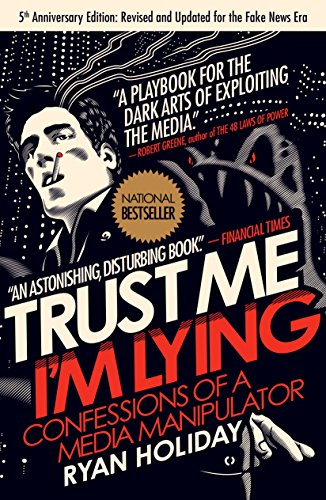
- Confessions of a media manipulator
Introduction
- I no longer expect to be informed when manipulation is so easy for bloggers and marketers to profit from
Book 1: Feeding the Monster
Chapter 1: How blogs work
- We’re a country governed by public opinion, which is largely governed by the press, but what governs the press?
- Blogs need things to cover
- Cycle: political blogs need things to cover, treading carefully increases during election -> reality (election far away) does not align with this -> political blogs create candidates early; move up start of election cycle -> the person they cover, by nature of coverage, becomes actual candidate (or president) -> blogs profit (literally), the public loses
- Blogging creates artificial content, which is made real and impacts the outcome of real world events
Chapter 2: How to turn nothing into something in three way-too-easy steps
- 89 percent of journalists report using blogs for their research for stories
Chapter 3: The Blog Con
- Blogs make their money from selling advertisements
- Traffic is money
- Exclusives build blogs
- Blogs are built to be sold
Chapter 4: Tactic #1 Bloggers are poor; help pay their bills
Chapter 5: Tactic #2 Tell them what they want to hear
- Blogs love press releases
- Write press releases for everything. Open a new store? Press release. Launch a new product? Press release. Launch a new color of a new product? Press release
- Use websites like PRWeb to post press releases
Chapter 6: Tactic #3 Give them what spreads, not what's good
- 'If it doesn't spread, it's dead.' - Henry Jenkins
- 'If something is a total bummer, people don't share it.' - Jonah Peretti
- The most powerful predictor of what spreads online is anger
- Sadness depresses our impulse for social sharing
- No marketer is ever going to push something with the stink of reasonableness, complexity, or mixed emotions
Chapter 7: Tactic #4 Help them trick their readers
- “The key is to get the whole story into the headline but leave out just enough that people will want to click” - Brian Moylan
Chapter 8: Tactic #5 Sell then something they can sell
- The earliest forms of newspapers were a function of political parties to give party members information they wanted
- Selling stories one-off distorts the news. Subscriptions are a better model because it keeps you honest to the reader cause the reader can always unsubscribe
- The Harder They Fall #book
- All the King's Men #book
- RSS has died. And so has the concept of subscribing. (this is interesting, I wonder what his take would be today with substack, wall street journal, and podcasts)
- The death of subscription means that instead of attempting to provide value to you, the longtime reader, blogs are constantly chasing other readers
Chapter 9: Tactic #6 Make it all about the headline
- 'People respond to and are deceived by the same things they were a hundred years ago.' - Ricky Jay
- How can we make our item stick out from all the other ones?
- Blogs aren't going to write about you or your story unless it can be turned into a headline that will drive traffic
Chapter 10: Tactic #7 Kill 'em with pageview kindness
- Gawker.com/stats
- Writers think of everything except 'is what I am making any good?'
Chapter 11: Tactic #8 Use the technology against itself
- Unless readers can see the end of your post coming around eight hundred words in, they’re going to stop
- 100-200 words is the ideal length. Any good idea can be expressed at that length
- Small, short paragraphs. 1-2 sentences
Chapter 12: Tactic #9 Just make stuff up (everyone else is doing it)
- Bloggers are able to find the angle
Book 2: The monster attacks. What blogs mean
Chapter 13: Irin Carmen, the daily show, and me. The perfect storm of how toxic blogging can be
Chapter 14: There are others. The manipulator hall of fame
- The best way to make your critics work for you is to make them irrationally angry
Chapter 15: Cute but evil. Online entertainment tactics that drug you and me
- Everything you consume online has been optimized to make you dependent on it
- “Talkativeness is afraid of the silence which reveals its emptiness.” - Kierkegaard
Chapter 16: The link economy. The leveraged illusion of sourcing
- May become is becomes has
Chapter 17: Extortion via the web. Facing the online shakedown
Chapter 18: The iterative hustle. Online journalism’s bogus philosophy
- Getting it right is expensive. Getting it first is cheap
- Iterative journalism makes the news cheap to produce but expensive to read because it can be false
Chapter 19: the myth of corrections
- Science shows that we are not only bad at remaining skeptical, we’re bad at correcting our beliefs when they’re proven wrong
Chapter 20: Cheering on our own deception
- “Our illusions are the house in which we live; they are our news, our heroes, our adventure, our forms of art, our very experience.” - Daniel Boorstin
Chapter 21: The dark side of snark. When internet humor attacks
- “We grow tired of everything but turning other into ridicule, and congratulating ourselves on their defects.” - William Hazlitt
- Dealing with snark comments is like jujitsu: the energy you’d exert in your defense will be used against you to make the embarrassment worse
- Snark is not the response of the masses to the inane doublespeak of politicians. It’s a defense mechanism, for writers, who, have nothing to say, or absolutely terrified of being criticized or derided. Snarky writing reflects primal fear — the fear of being laughed at. Snarky writers don’t want to be mocked, so they strike first by mocking everyone insight.
- Snark makes the speaker feel strength they know deep down they do not possess. It shields their insecurity and makes the writer feel like they are in control
- To be called a douche is to be branded with all the characteristics of what society deigns to hate but can’t define. It’s a way to dismiss someone entirely without doing any of the work or providing any of the reasons
Chapter 22: The 21st-century degradation ceremony: blogs as machines of hatred and punishment
- Greek tragedies taught the audience to think about how easily an unfortunate situation could befall them, and to be humbled by the flaws of another person
Chapter 23: Welcome to unreality
- Only the unexpected makes the news
- Fake events do better than real ones
Chapter 24: How to read a blog. An update on account of all the lies
- When you see a blog behind with “according to a tipster” or “we’re hearing reports” know it’s probably made up
- If you see “leak”, someone emailed them and the sources are almost certainly not official and are usually fake
- If you see “breaking” or “we’ll have more details as the story develops,” what you’re reading reached you too soon. There was no wait and see, no attempt at confirmation, no internal debate over whether the importance of the story necessitated abandoning caution
- When you see “updates” on a story or articles know that no one actually bothers to rework the story in light of the new facts
- When you see “sources tell us” know that these sources are not vetted, they are rarely corroborated, and they are desperate for attention
- Our knowledge and I understanding is an empty hollow shell. What we think we know turns out to be based on nothing, or worse than nothing—misdirection and embellishment. Our facts aren’t facts, they are opinions dressed up like facts. Our opinions aren’t opinions; they are emotions that feel like options
Conclusion: so, where to from here
- TV creates a fake world to fit its needs, and we, the audience, watched that fake world on TV, imitated it, and it became the new reality in which we lived
- Surrounded by illusions, we lash out at our fellow man for his very humanness
- “The first job of the journalist is to ask, ‘is this information true?’” - Ed Wallace
- Blogs refuse to accept this mantle and only focus on pageviews
#SharedFromTwos ✌️