

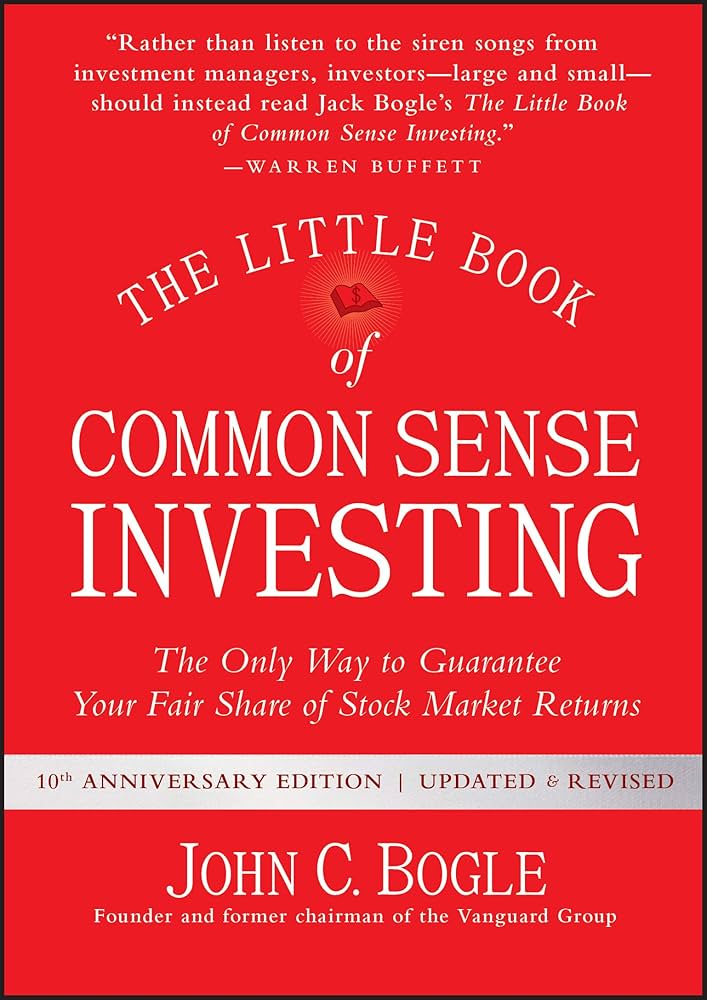
- The Only Way to Guarantee Your Fair Share of Stock Market Returns
- The winning strategy is to own all of the nation’s publicly held businesses at very low cost.
- The best way to implement this strategy is indeed simple: Buying a fund that holds this market portfolio, and holding it forever. Such a fund is called an index fund.
- Fund investors are confident that they can easily select superior fund managers. They are wrong.
- Index funds eliminate the risks of individual stocks, market sectors, and manager selection. Only stock market risk remains.
- The index fund is indeed the only investment that guarantees you will capture your fair share of the returns that business earns.
- The magic of compounding is little short of a miracle.
- Academic studies suggest that if you are a typical investor in individual stocks, your returns have probably lagged the market by about 2.5 percentage points per year.
- After the deduction of the costs of investing, beating the stock market is a loser’s game.
- Fund investors are confident that they can easily select superior fund managers. They are wrong.
- Mutual funds charge two percent per year and then brokers switch people between funds, costing another three to four percentage points. The poor guy in the general public is getting a terrible product from the professionals.
- You will almost never find a fund manager who can repeatedly beat the market. It is better to invest in an indexed fund that promises a market return but with significantly lower fees.
- Get rid of all your Helpers. Then our family will again reap 100 percent of the pie that Corporate America bakes for us.
- For investors as a whole, returns decrease as motion increases.
- Don’t do something. Just stand there.
- The higher the level of their investment activity, the greater the cost of financial intermediation and taxes, the less the net return that the business owners as a group receive.
- The investment business is a giant scam. Most people think they can find managers who can outperform, but most people are wrong. I will say that 85 to 90 percent of managers fail to match their benchmarks. Because managers have fees and incur transaction costs, you know that in the aggregate they are deleting value.
- First, get diversified. Come up with a portfolio that covers a lot of asset classes. Second, you want to keep your fees low. That means avoiding the most hyped but expensive funds, in favor of low-cost index funds. And finally, invest for the long term. [Investors] should simply have index funds to keep their fees low and their taxes down. No doubt about it.
- Experience conclusively shows that index-fund buyers are likely to obtain results exceeding those of the typical fund manager, whose large advisory fees and substantial portfolio turnover tend to reduce investment yields.
- The index fund is a sensible, serviceable method for obtaining the market’s rate of return with absolutely no effort and minimal expense.
- Over time, the aggregate gains made by shareholders must of necessity match the business gains of the company.
- Ignore the short-term noise of the emotions reflected in our financial markets and focus on the productive long-term economics of our corporate businesses.
- “In the short run the stock market is a voting machine . . . (but) in the long run it is a weighing machine.” - Benjamin Graham
- Occam’s Razor: When there are multiple solutions to a problem, choose the simplest one.
- By far the simplest way to own all of U.S. business is to hold the total stock market portfolio.
- A minuscule 4 percent of funds produce market-beating after-tax results with a scant 0.6 percent (annual) margin of gain. The 96 percent of funds that fail to meet or beat the Vanguard 500 Index Fund lose by a wealth-destroying margin of 4.8 percent per annum.
- All investors as a group must necessarily earn precisely the market return, but only before the costs of investing are deducted.
- There are two certainties: (1) Beating the market before costs is a zero-sum game; (2) Beating the market after costs is a loser’s game.
- For individual investors holding stocks directly, trading costs average about 1.5 percent per year. That cost is lower (about 1 percent) for those who trade infrequently, and much higher for investors who trade frequently.
- We investors as a group get precisely what we don’t pay for. So if we pay nothing, we get everything.
- Never forget: Market return, minus cost, equals investor return.
- People ought to recognize that the average fund can never outperform the market in total.
- The beauty of the index fund, then, lies not only in its low expenses, but in its elimination of all those tempting fund choices that promise so much and deliver so little. Unlike the hot funds of the day, the index fund can be held through thick and thin for an investment lifetime, and emotions need never enter the equation. The winning formula for success in investing is owning the entire stock market through an index fund, and then doing nothing. Just stay the course.
- The wise Warren Buffett shares my view, in what I call his “four E’s.” “The greatest Enemies of the Equity investor are Expenses and Emotions.”
- Managed mutual funds are astonishingly tax-inefficient.
- Most fund managers, once focused on long-term investment, are now focused on short-term speculation. But the index fund follows precisely the opposite policy—buying and holding forever, and incurring transaction costs that are somewhere between infinitesimal and zero.
- Fund returns are devastated by costs, taxes, and inflation.
- Index funds do not trade from security to security and, thus, they tend to avoid capital gains taxes.
- Avoid performance chasing based on short-term returns, especially during great bull markets.
- Buying funds based purely on their past performance is one of the stupidest things an investor can do.
- Average return of funds recommended by advisors: 2.9 percent per year. For equity funds purchased directly: 6.6 percent.
- The best time to sell a new fund to investors—when it’s hot—is often the worst time to buy it.
- You can outperform more than 80 percent of your fellow investors over the next several decades simply by investing in an index fund—and doing nothing else.
- Index funds endure, while most advisers and funds do not.
- Your adviser’s fees should be reasonable. It is simply not worth paying anybody more than 1 percent to manage your money. Above $1 million, you should be paying no more than 0.75 percent, and above $5 million, no more than 0.5 percent. . . . Your adviser should use index/passive stock funds wherever possible. If he tells you that he is able to find managers who can beat the indexes, he is fooling both you and himself.
- Costs account for most of the difference in the annual net returns earned by the funds.
- The classic index fund had the lowest costs of all: an expense ratio averaging 0.2 percent per year during this period. With no measurable turnover costs, its total all-in costs were but 0.2 percent.
- All index funds are not created equal. Intelligent investors will select the lowest cost index funds that are available from reputable fund organizations.
- Your index fund should not be your manager’s cash cow. It should be your own cash cow.
- Among intermediate-term taxable bond funds, the low-cost index fund is truly a superior performer.
- Among long-term tax-exempt bond funds, once again, indexing wins.
- Among short-term Treasury funds, the lowest cost option wins again
- Smart investors will save themselves lots of money—and substantially improve their returns—if they apply the same principles of broad diversification, low-cost, no-load, minimal turnover, and long-term investing when they select fixed income funds. These are the very commonsense characteristics that enable index funds to guarantee your fair share of the returns in the bond and money markets, even as they do in all financial markets.
- “The greatest enemy of a good plan is the dream of a perfect plan.” Stick to the good plan.
- The majority of investors should be satisfied with the reasonably good return obtainable from a defensive portfolio. Because “[the majority of investors] do not have the time, or the determination, or the mental equipment to embark upon such investing as a quasi-business. They should therefore be satisfied with the reasonably good return obtainable from a defensive portfolio, and they should stoutly resist the recurrent temptation to increase this return by deviating into other paths.
- Unsoundly managed funds can produce spectacular but largely illusionary profits for a while, followed inevitably by calamitous losses.
- Graham also would have been appalled, not only by the enormous (100 percent-plus) increase in those once-reasonable fund expenses, but also by the incredible increase in stock trading in mutual fund portfolios.
- The real money in investment will be made not out of buying and selling but of owning and holding securities.
- The two sources of the superior returns of the index fund: (1) the broadest possible diversification; and (2) the tiniest possible costs.
- Commonsense rules:
1. Over the long term, stock market returns are created by real investment returns earned by real businesses—the annual dividend yield on publicly held U.S. corporations, plus their subsequent rate of earnings growth.
2. Over the short run, illusory speculative returns, caused by the impact of the change in the amount investors are willing to pay for each dollar of corporate earnings, can increase or decrease investment returns. But in the long run, the impact of speculative return washes out. QED 1: In investing, the winning strategy for reaping the rewards of capitalism depends on owning businesses, not trading stocks.
3. Individual businesses come and go. Given the rapid pace of technological change we face today, alongwith powerful new global competition, the failure rate of individual corporations is hardly likely to falter and may well increase. The best protection for individual investors from the risks inherent in individual stocks is the broadest possible diversification. QED 2: Owning businesss in the aggregate through an all-market index fund is the consummate risk-reduction strategy. (Broad economic risks to corporate earnings and dividends, however, cannot be diversified away.)
4. As a group, all investors in the stock market earn its gross returns. When the market provides an 8 percent return, investors divide up 8 percent (before taking account of costs). What else is new?
5. While investors earn the market’s entire return, they do not capture the market’s entire return. Rather, they capture the market’s return only after the costs of financial intermediation are deducted—commissions, management fees, marketing costs, sales loads, administrative expenses, legal expenses and custodial fees, and so on. Unnecessary taxes simply enlarge the gap. QED 3: Gross market return, minus costs, equals net return for investors as a group. (Again, remember the Gotrocks family.)
6. While all investors as a group must earn the market’s net return, mutual fund investors, betrayed by their emotions (and by the fund industry) into serious errors in market timing and fund selection, have done much worse. While that gap may shrink, it is virtually inconceivable that it will be eliminated. QED 4: Gross market return, minus costs, minus timing and selection penalties, equals the net return earned by mutual fund investors as a group.
- “Invest in low-turnover, passively managed index funds . . . and stay away from profit-driven investment management organizations. . . The mutual fund industry is a colossal failure . . . resulting from its systematic exploitation of individual investors . . . as funds extract enormous sums from investors in exchange for providing a shocking disservice. . . . Excessive management fees take their toll, and (manager) profits dominate fiduciary responsibility.” - David Swensen
- “By periodically investing in an index fund, the know-nothing investor can actually out-perform most investment professionals. Paradoxically, when ‘dumb’ money acknowledges its limitations, it ceases to be dumb. . . . Those index funds that are very low cost . . . are investor-friendly by definition and are the best selection for most of those who wish to own equities.” - Warren Buffett
- The vast majority of American families will be well served by owning their equity holdings in an all-U.S. stock-market index portfolio and holding their bonds in an all-U.S. bond-market index portfolio.
- While an index-driven strategy may not be the best investment strategy ever devised, the number of investment strategies that are worse is infinite.
- Instead of index funds, we opt for costly active funds and trade them to excess. Why? We are sold funds more often than we buy them. We have far too much self-confidence. We crave excitement. We succumb to the distraction that is the stock market. We fail to understand the arithmetic of investing, and the arithmetic of mutual funds.
- If you crave excitement, I would encourage you to do exactly that. Life is short. If you want to enjoy the fun, enjoy! But not with one penny more than 5 percent of your investment assets.
- My favorite rule of thumb is (roughly) to hold a bond position equal to your age—20 percent when you are 20, 70 percent when you’re 70, and so on—or maybe even your age minus 10 percent.
- “Some simple, but not easy, advice for good investing and financial planning in general includes: diversify widely . . . keep costs low . . . rebalance in a disciplined fashion . . . spend less . . . save more . . . make less heroic assumptions about future returns . . . when something sounds like a free lunch, assume it is not free unless very convincing arguments are made—and then check again . . . stop watching the stock markets . . . work less on investing, not more. . . . In true Hippocratic fashion: Do No Harm! You do not need a magic bullet. Little can change the fact that current expected returns on a broad set of asset classes are low versus history. Stick to the basics with discipline.” - Cliff Asness
- “If you would be wealthy, think of Saving as well as Getting. . . . Remember that time is money. . . . Beware of little Expenses; a small Leak will sink a great Ship. . . . There are no Gains, without Pains. . . . He that would catch Fish, must venture his Bait. . . . Great Estates may venture more, but little Boats should keep near shore. . . . Tis easy to see, hard to foresee. . . . Industry, Perseverance, and Frugality make Fortune yield.” - Benjamin Franklin
- “The creation of the first index fund by John Bogle was the equivalent of the invention of the wheel and the alphabet.” - Dr. Paul Samuelson
Shared from Twos ✌️