

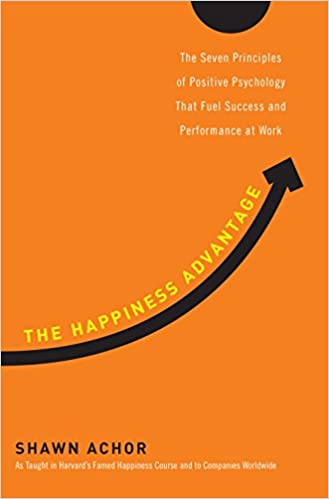
The formula of success first and happiness second is wrong
Happiness and optimism fuels performance and achievement
Waiting to be happy limits our brains potential for success, whereas cultivating positive brains makes us more motivated, efficient, resilient, creative, and productive, which drives performance upward
“The mind is it’s own place, and in itself can make a heaven of hell, a hell of heaven” - John Milton
The students who were focused on the stress and pressure—the ones who saw learning as a chore—were missing out on all the opportunities right in front of them. But those who saw it as a privilege seemed to shine even brighter
If we study merely what is average, we will remain merely average
If all you strive for is diminishing the bad, you’ll only attain average and you’ll miss out entirely on the opportunity to exceed the average
What we spend our time and mental energy focusing on becomes our reality
Our brains are hardwired to perform at their best not when they are negative or even neutral, but when they are positive
Our hard-driving lives leave us feeling stressed, and we feel swamped by the mounting pressure to succeed at any cost
Don’t paint a happy face, use “positive thinking” to wish away your problems, or worse, to pretend your problems don’t exist. This view is deluded
Be realistic about the present while maximizing our potential for the future
Happiness is not the belief that we don’t need to change; it is the realization that we can
The belief that we are just our genes is one of the most pernicious myths in modern culture—the notion that people come into the world with a fixed set of abilities and that they, and their brains, cannot change
We do not know the limits of human potential
People can become happier, pessimists can become optimists, and stressed and negative brains can be trained to see more possibility. The competitive advantage is available to all who put in the effort
Principle #1: The happiness advantage
When we are happy—when our mindset and mood are positive—we are smarter, more motivated, and thus more successful. Happiness is the center, and success revolves around it
There is no single meaning; happiness is relative to the person experiencing it
The best judge of how happy you are is you
Scientists define happiness as the experience of positive emotions—pleasure combined with deeper feelings of meaning and purpose
Happiness implies a positive mood in the present and a positive outlook for the future
Martin Seligman breaks happiness down into three, measurable components: pleasure, engagement, and meaning
Aristotle defined happiness as eudaimonia, which translates not directly to “happiness” but to “human flourishing.”
Happiness is the joy we feel striving after our potential
The chief engine of happiness is positive emotions, since happiness is a feeling
Barbara Fredrickson describes the ten most common positive emotions: joy, gratitude, serenity, interest, hope, Pride, amusement, inspiration, awe, and love
Happy CEOs are more likely to lead teams of employees who are both happy and healthy, and who find their work climate conductive to high performance
Happiness can improve our physical health, which in turn keeps us working faster and longer and therefore makes us more likely to succeed
Instead of narrowing our actions down to fight or flight as negative emotions do, positive ones broaden the amount of possibilities we process, making us more thoughtful, creative, and open to new ideas
Positive emotions actually expand our peripheral line of vision
Happiness gives us an edge in the workplace for thinking of out-of-box solutions, spotting opportunities, and seeing how to build upon the ideas of others
Every time employees experience a small burst of happiness, they get primed for creativity and innovation. They see solutions they might otherwise have missed
A quick burst of positive emotions doesn’t just broaden our cognitive capacity; it also provides a quick and powerful antidote to stress and anxiety, which in turn improves our focus and our ability to function at our best level
Bosses should stress the positives, with encouraging words, or a reminder of the chief strengths the employee brings to the table
Employees can employ any number of techniques to boost positivity and build confidence: visualizing themselves giving a clear and cogent presentation, recalling a past instance when making a successful business pitch, or taking a moment to do something entirely unrelated to work that makes them happy—making a quick call to a friend, reading a funny article online, watching a two-minute video, or taking a brisk walk around the block
Everyone has one or two quick activities they know will make them smile, and however trivial they may feel, their benefits are worth it
Happiness is not just a mood—it’s a work ethic
While we each have a happiness baseline that we fluctuate around on a daily basis, with concerted effort, we can raise that baseline permanently so that even when we are going up and down, we are doing so at a higher level
Monks who spend years meditating grow their left prefrontal cortex, the part of the brain most responsible for feeling happy
Regular meditation can permanently require the brain to raise levels of happiness, lower stress, even improve immune function
Often, the most enjoyable part of an activity is the anticipation of it. Anticipating future rewards can actually light up the pleasure centers in your brain much as the actual reward will
Acts of altruism—giving to friends and strangers alike—decrease stress and strongly contribute to enhances mental health
Exercise boosts mood and enhances our work performance by improving motivation and feelings of mastery, reducing stress and anxiety, and helping us get into flow—that “locked in” feeling of total engagement that we usually get when we’re at our most productive
Exercise is as helpful as antidepressants
Money can buy happiness, but only if used to do things as opposed to simply have things
While the positive feelings we get from material objects are frustratingly fleeting, spending money on experiences, especially ones with other people, produces positive emotions that are both more meaningful and more lasting
www.viasurvey.org to find your top five signature strengths of character
Sacrificing positivity in the name of time management and efficiency actually slows us down
The smallest moments of positivity in the workplace can enhance efficiency, motivation, creativity, and productivity
Provide frequent recognition and encouragement
When recognition is specific and deliberately delivered, it is even more motivating then money
It takes about 3 positive comments, experiences, or expressions to fend off the languishing effects of one negative
Principle #2: The Fulcrum and the Lever
Because our brain’s resources are limited, we are left with a choice: to use those finite resources to see only pain, negativity, stress, and uncertainty, or to use those resources to look at things through a lens of gratitude, hope, resilience, optimism, and meaning
While we of course can’t change reality through sheer force of will alone, we can use our brains to change how we process the world, and that in turn changes how we react to it
“Give me a lever long enough and a fulcrum on which to place it, and I shall move the world.” - Archimedes
Our power to maximize our potential is based on two important things:
The length of our lever—how much potential power and possibility we believe we have
The position of our fulcrum—the mindset with which we generate the power to change
We don’t need to try so hard to generate power and produce results. The more we move our mindset, the more power we generate
The mental construction of our daily activities, more than the activity itself, defines our reality
When we reconnect ourselves with the pleasure of the “means,” as opposed to only focusing on the “ends,” we adopt a mindset more conducive not only to enjoyment, but to better results
Ignore the constraints of activities entirely and think only if the intrinsic value you derive from the activity itself, instead of simply when it is “due.” Stop focusing only on how you will “use” the material you are reading later on
If our mindset conceives of free time, hobby time, or family time as nonproductive, then we will make it a waste of time. Free time is a chance to learn and practice new things, to recharge your batteries and connect with others, and you’ll be able to leverage the power of that rest time and return stronger than before
The more you believe in your own ability to succeed, the more likely it is that you will
Specific and concerted focus on your strengths during a difficult task produces the best results
More important than believing in your own abilities is believing that you can improve these abilities
“Everyone can change and grow through application and experience” - Carol Dweck
When we believe there will be a positive payoff for our effort, we work harder instead of succumbing to helplessness
Beliefs are so powerful because they dictate our efforts and actions
The more we can align our daily tasks with our personal vision, the more likely we are to see work as a calling
Principle #3: The Tetris Effect
Constantly scanning the works for the negative comes with a great cost. It undercuts our creativity, raises our stress levels, and lowers our motivation and ability to accomplish our goals
Scientists estimate that we remember only one of every 100 pieces of information we receive
When our brains constantly scan for and focus on the positive, we profit from three of the most important tools available to us: happiness, gratitude, and optimism
Making a list of three things you are grateful for or writing for 20 minutes about an experience you are grateful for helps you look for the positives throughout your daily life
Principle #4: Falling up
“We are not imprisoned by our circumstances, our setbacks, our history, our mistakes, or even staggering defeats along the way. We are freed by our choices.” - Jim Collins
By scanning our mental map for positive opportunities, and by rejecting the belief that every down in life leads us only further downward, we give ourselves the greatest power possible: the ability to move up not despite the setbacks, but because of them
The people who can most successfully get themselves up off the mat are those who define themselves not by what has happened to them, but by what they can make out of what has happened. These are the people who actually use adversity to find the path forward
“Things do not necessarily happen for the best, but some people are able to make the best out of things that happen.” - Tal Ben-Shahar
The most successful people see adversity not as a stumbling block, but as a steppingstone to greatness
The most successful among us know that it is not the adversity itself, but what we do with it that determines our fate
Adversities, no matter what they are, simply don’t hit us as hard as we think they will
Principle #5: The Zorro Circle
People who feel in control at work also have lower levels of stress, work-family conflict, and job turnover
The most successful people, in work and in life, are those who have an internal locus of control, the belief that their actions have a direct effect on their outcomes. People with an external locus, on the other hand, are more likely to see daily events are dictated by external forces
Someone with an internal locus will look for what they can do better and will work to improve
When people are primed to feel high levels of distress, the quickest to recover are those who can identify how they are feeling and put those feelings into words. Whether you do it by writing down feelings in a journal or talking to a trusted coworker, verbalizing the stress and helplessness you are feeling is the first step toward regaining control
Once you’ve mastered the self awareness circle, your next goal should be to identify which aspects of the situation you have control over and which you don’t
By tackling one small challenge at a time—a narrow circle that slowly expands outward—we can relearn that our actions do have a direct effect on our outcomes, that we are largely the masters of our own fates
When the challenges we face are particularly challenging and the payoff remains far away, setting smaller, more manageable goals helps us build our confidence and celebrate forward progress, and keeps us committed to the task at hand
Principle #6: The 20-Second Rule
Common sense is not common action
To be excellent we cannot simply think or feel excellent, we must act excellently
Humans are biologically prone to habit, and it is because we are mere bundles of habits that we are able to automatically perform many of our daily tasks
Habits are like financial capital—forming one today is an investment that will automatically give out returns for years to come
“A tendency to act only becomes effectively ingrained in us in proportion to the uninterrupted frequency with which the actions actually occur, and the brain grows to their use.” - William James
Habits form because our brain actually changes in response to frequent practice
Americans find free time more difficult to enjoy than work
Our jobs require us to us our skills, engage our minds, and pursued our goals—all things that have been shown to contribute to happiness
We are drawn to the things that are easy, convenient, and habitual, and it is incredibly difficult to overcome inertia
The average employee gets interrupted from their work every 11 minutes, and on each occasion experiences a loss of concentration and flow that takes almost as many minutes to recover from
Today, there is a universe of diversions to buy, hear, watch and forward, which makes focusing on a task all the more challenging
It’s not the sheer number and volume of distractions that gets us into trouble; it’s the ease of access to them
The more we can lower or even eliminate the activation energy for our desired actions, the more we enhance our ability to jump start positive change
Principle #7: Social investment
Our relationships with other people matter, and matter more than anything else in the world
The more social support you have, the happier you are. The happier you are, the more advantages you accrue in nearly every domain of life
The more team members are encouraged to socialize and interact face to face, the more engaged they feel, the more energy they have, and the longer they can stay focused on a task
Smiling tricks your brain into thinking you’re happy, so it starts producing neurochemicals that actually do make you happy
Shared from Twos ✌️