

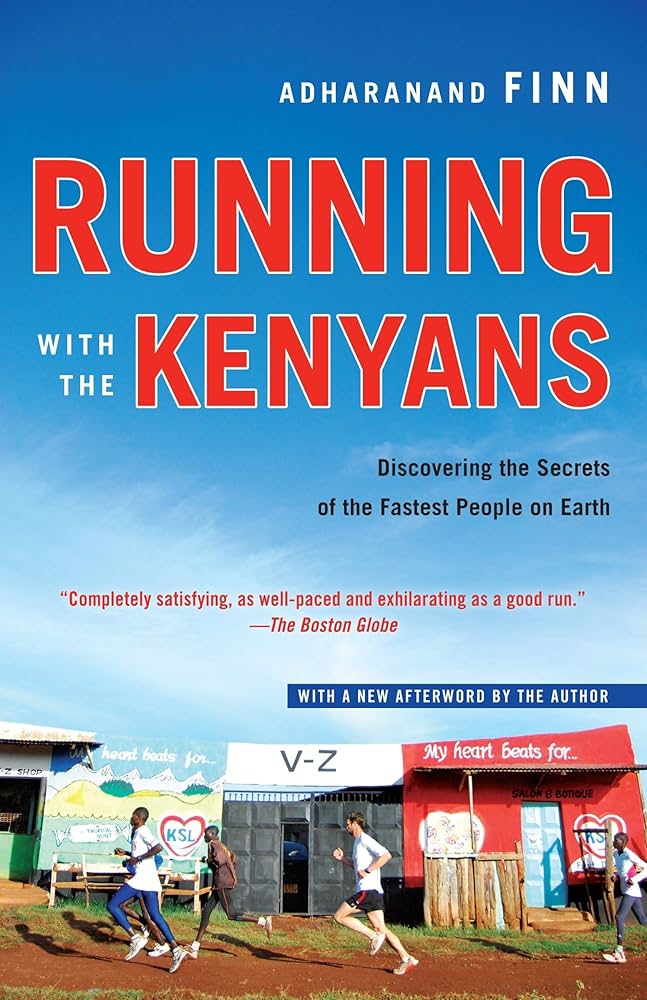
Passion, Adventure, and the Secrets of the Fastest People on Earth
“When the divine is looking for you, that’s a pretty powerful force.” — Prem Rawat
It isn’t that I want to achieve any specific goal; I just don’t want to look back one day and regret that I never gave myself a decent chance to see what I could do.
One woman tells me, as we sit on the grass, that she thinks running is like getting drunk in reverse. With drinking, it feels great at first, but then you start feeling awful. With running, you feel awful at first, but then, after you finish, you feel great.
One of the athletes explains to me that they don’t like to run on concrete, so they walk until they get to the grass. In Kenya, he says, they run only on dirt roads.
Back at the house, Micah cooks up some ugali and green vegetables for everyone’s lunch. Ugali is the runners’ favorite food. It’s basically maize our and water boiled up to make a white, sticky dough. Micah cuts me a huge slab with a knife and lays it on the plate on top of the vegetables. It has a soft, moist texture but doesn’t taste of much. The athletes, however, love it. They tell me, only half-joking, that it’s the secret to Kenya’s running success. Packets of maize our brought over from Kenya are piled up on the floor in a corner of the kitchen.
“In Kenya,” says Vivian, “there are only athletes.” It isn’t a boast, but merely a statement of fact. In Kenya, it would seem, if you are an athlete, you run. If you aren’t, you don’t.
McDougall talks about a theory developed by Harvard scientists that humans evolved in the way we did partly because we hunted by running animals into the ground. While we are painfully slow at sprinting compared to most four-legged creatures—say, the cheetah, horse, rabbit, or a thousand others—when it comes to long-distance running, we are the Olympic champions of the animal kingdom. Our key advantage is our ability to shed most of our heat through sweating. This means we can cool ourselves down on the move, while most other animals need to stop when they get too hot in order to pant their heat away. Our ancestors could chase even the swiftest runners like antelope until they literally dropped dead from overheating, and McDougall’s book recounts a story about bushmen in the Kalahari Desert in Namibia who still do this today.
The scientists claim, in effect, that humans are born to run long distances, that our bodies are designed specifically for the purpose. It’s why we have Achilles tendons, arched feet, big bums—to help keep us balanced when we run—and a nuchal ligament at the back of our necks (to keep our heads still). And we are designed to run, they say, in bare feet. Running shoes only mess things up.
Injuries are a common part of being a runner, so I didn’t panic. Depending on which study you read, somewhere between 60 and 80 percent of runners get injured at least once a year.
The reason runners get injured so often, he says, is because they land heel first. And the reason they land heel first is because they wear stability trainers.
Take o the shoes. Our body is the perfect running machine, they say, developed over millions of years of product testing and fine tuning. We don’t need the modern invention of running shoes to do something we’ve been doing perfectly well for millennia.
Because they grow up running barefoot, Kenyans have a
completely different style of running. Rather than landing heel first, they land forefoot first. Not only does this reduce the risk of injury, but it is a more efficient way of running. In effect, by landing heel first, most Western runners are braking with every stride. No wonder we can’t keep up.
Why don’t the top African runners actually run barefoot in races? I ask. “A top runner can’t afford to hurt himself stepping on a sharp stone,” he says. “But they wear racing flats. There is no stability or cushioning on running flats. They allow you to run in a barefoot style. They don’t force you to land heel first like most running shoes.”
“Your body won’t let you run heel first if you’re barefoot,” he says. “It would be too painful.” With shoes on we have a false sense of security, and feel that we can hammer the road as hard as we want. But the impact from landing heel first is still shooting up the leg, juddering the knees, the hips, the back, regardless of how much cushioning you put under your feet. In fact, because you can’t feel the ground when you’re wearing shoes, you’re forced to land even harder as your body instinctively looks for stability and a harder surface. Without shoes, however, you’re forced to tread lightly, skipping gently over the ground. Your body just does it naturally.
He tells me to keep my head up, lead with my chest, and pull my legs through, as though I’m on a unicycle. If that isn’t enough to think about, he starts a metronome going at a rapid-re tack tack tack. I have to match it stride for tack, as he films me.
The whole notion of barefoot running appeals to me. I love it when, after years of research, we realize that the most natural and primitive way to do something—the way we always did it before scientists and corporations got their hands on it—was actually the best way after all. I love the fact that despite all our technological advancements, poor Kenyans running barefoot have the edge over us. As a notion, it’s brilliant. But as a reality? The only way to find out is to try it.
Even if you never become an Olympic champion, or even manage to race abroad, just being an athlete here seems to lift you above the chaos of daily life. It marks you out as one of the special people, who have chosen a path of dedication and commitment.
Running matters.
“Try.”
Godfrey must be the world’s most friendly, helpful man, but sometimes that can be a problem. He says yes to everything.
“The runners all come from poor backgrounds, with less education,” he says. “When they win, the whole village celebrates their victory, and everyone asks for support. The successful athlete becomes like the chief of the village, so then everyone goes to him with their personal problems.” “The athletes need to concentrate on their training,” he says. “They need to educate their villagers about their life.”
Under the heading “Secrets” in my notebook, I jot down the words focus, dedication, training camps.
“The Kenyan runners don’t understand the longer-term view. So if you oer them five hundred dollars up front, they’ll jump at it, even if the terms of the contract mean they’ll lose out in the long term.”
“An athlete can’t keep in good shape forever.”
They’re just here to run. They don’t seem to dwell on whether it’s fair or not.
Hope, or optimism, or a lack of alternatives drive many of the Kenyans on. But you can’t eat hope.
For Kenyan runners rest is a serious business. None of the athletes have jobs. Even the athletes who don’t live in the camps rarely do anything other than run, eat, and sleep.
Without a job, most of them rely on the kindness of relatives, or other successful runners, to see them through. They don’t require much, living frugal lives, with no electricity or running water, and eating a simple diet of rice, beans, and ugali.
I spoke to some top British athletes who had come to Kenya to train and I asked them what they thought the biggest difference was between the Kenyans’ training and their own. “Rest,” they all said unanimously. “In England when we’re not running, we go shopping, cook food, meet up with friends. Here they just rest.”
“I ran a lot on grass tracks in those days and it was just much easier in bare feet. I could adapt more quickly to changes in the uneven surface. Also, when I ran barefoot, I had a shorter stride and a faster leg turnover.”
The biggest advantage of running barefoot is that it forces you to adopt a better running style. Without shoes on, all the senses in your feet are suddenly activated, and your inbuilt running software, developed over millions of years, is switched on. You instinctively start to control your impact on the ground, landing lightly on your feet. You quickly learn that the energy you put into the ground, as your foot lands, will return and propel you on.
So we have to start slowly. Barefoot shoes can help protect the soles of our feet from abrasions, but we still need to start with short, gentle runs. It takes time, and we get out of shape. But if we stick to it, our muscles will strengthen, and our style will start to change. And as our foot muscles strengthen, our arches will rise. Arches are like springs, and the higher they are, the more spring we have in our step.
Nobody keeps a training log or adds up their weekly mileage. Each session is forgotten as soon as it is done. The timing is just a way of structuring the training, of telling them when to start and when to stop.
Once you decide where you’re going to stop, it takes a reckless surge of energy to overrule yourself.
Now that running is firmly established as the way out, as football is in Brazil or cricket is in India, all over the Rift Valley people like Beatrice and Japhet are taking it up in the thousands, and the result is that Kenya is now dominating long-distance running even more than ever.
Harambee is a Kenyan tradition, in which a whole community will come together to help itself. It literally means “all pull together” and is the official motto of Kenya.
“When a Kenyan wins a medal, or a large amount of money,” says Toby, “he reflects on the journey that took him to that moment, and he realizes, perhaps better than we do, that no person achieves without the help and support of those around him.”
The majority of the people in the Rift Valley are brought up as subsistence farmers, so when the athletes win any money, the first thing they do is buy a cow for milk. I can’t help thinking it would be easier and cheaper just to go to the shop and buy it every day. Every street has a tiny kiosk selling fresh milk for virtually nothing. But the mindset is to own a cow. A person without a cow is not really a person. You can judge the importance of someone by the number of cows he owns.
“Ask any top runner about his background,” he said, “and you will find out he comes from a poor family.”
Talking to Mercy Cherono, it was clear that her success hadn’t come as the result of years of dedication, being driven to training sessions and races by her parents. Her school probably didn’t even have a track to train on. Instead, simply from the inherent physical toughness of her daily life had come a talent to outrun the world.
“They all come from a poor, rural family. We’ve yet to have a good runner from a city.”
The life of the rural poor in Kenya is tough. From a young age children have to work hard, herding goats or digging in the fields, and they run or walk everywhere. You see them at dawn shuffling along the trails on their way to school. It’s the perfect groundwork for an endurance athlete.
There is a broad scientific consensus that training at high altitude helps endurance athletes to run faster by increasing their blood’s ability to carry oxygen around the body.
Kenyans are born and raised at altitude, running around everywhere from a young age, which gives them a big advantage.
“It’s true,” he says. “In the West, we have a good quality of life, no? But if you think about what ‘quality of life’ means, it means less fatigue. Making things easier. Running, on the other hand, is about how much fatigue can you do.”
My list is growing, but all the reasons—the secrets—that I’m discovering are beginning to join up. The tough, physical upbringing, the barefoot running, the altitude, the running to school, they all arise naturally from the Kenyans’ daily lives. None of it is done with the intention of becoming an athlete. It’s just how they live. Simply through growing up on the slopes of the Rift Valley, far from cities and the technologies that the West has invented to make life more comfortable, they have found themselves excelling at the world’s most natural sport.
“By the time a Kenyan is sixteen, he has built his house.”
Back in the 1970s we weren’t exactly running barefoot, but the majority of running shoes were thin soled and lightweight, much like the “barefoot shoes” selling like hotcakes today. And what’s more, we were growing up wearing them, which meant we had good form, strong calves, and higher arches.
With fewer role models and less potential for success, fewer people are willing to give up everything for a career in athletics. The fewer full-time athletes you have, the fewer stars are likely to emerge.
“Now I am learning how to run,” Japhet says. “Before, I used to go home too much to help my father on the shamba, with the cows. But I was wasting time. I keep correcting my mistakes. I saw Kipsang going to Paris and thought I could do that. Now I don’t go home so much, I just focus. I see others going home, not serious.”
It is this way of life that has gotten him to where he is now. To change it would be to risk everything. The athletes know that those who choose to leave the camps to live a more comfortable life often lose their edge. And with so much competition in this one tiny corner of the world, edge is something that is hard to get back once it is lost.
“Just don’t forget to breathe,” Jackie Chan tells him. It’s good advice.
“That’s because people who write for newspapers don’t know what they’re talking about,”
“In the West we put children in shoes before they can walk. What are we teaching them? We’re teaching them that the ground is dangerous, that they need to be protected from it. But Kenyan children can feel the ground, so they have a better relationship with it. They learn to place their foot carefully when they run, so they don’t hurt themselves. They learn to land gently, lightly, gliding over the earth rather than pounding it.”
“You people come to find the secret, but you know what the secret is? That you think there’s a secret. There is no secret.”
It’s dangerous to conclude that because so many people from one ethnic group win so many races that they must therefore have a genetic advantage. If that’s the case, the rest of the world might as well give up.
“If we push on, we begin to feel a vague, tingling sense of who, or what, we really are.”
Running is a brutal and emotional sport. It’s also a simple, primal sport. As humans, on a most basic level, we get hungry, we sleep, we yearn for love, we run. Just watch small children left to play unsupervised. They can’t stop running. It is part of what makes us human.
What really drives us is something else, this need to feel human, to reach below the multitude of layers of roles and responsibilities that society has placed on us, down below the company name tags, and even the father, husband, son labels, to the pure, raw human being underneath. At such moments, our rational mind becomes redundant. We move from thought to feeling.
Plantar fasciitis is every runner’s worst nightmare. It strikes out of nowhere and the only remedy is to stop running.
“Strength does not come from physical capacity. It comes from an indomitable will.” — Mahatma Gandhi
“When they see a hill, they see it as an opportunity. An opportunity to train harder, to work harder.”
Shared from Twos ✌️