

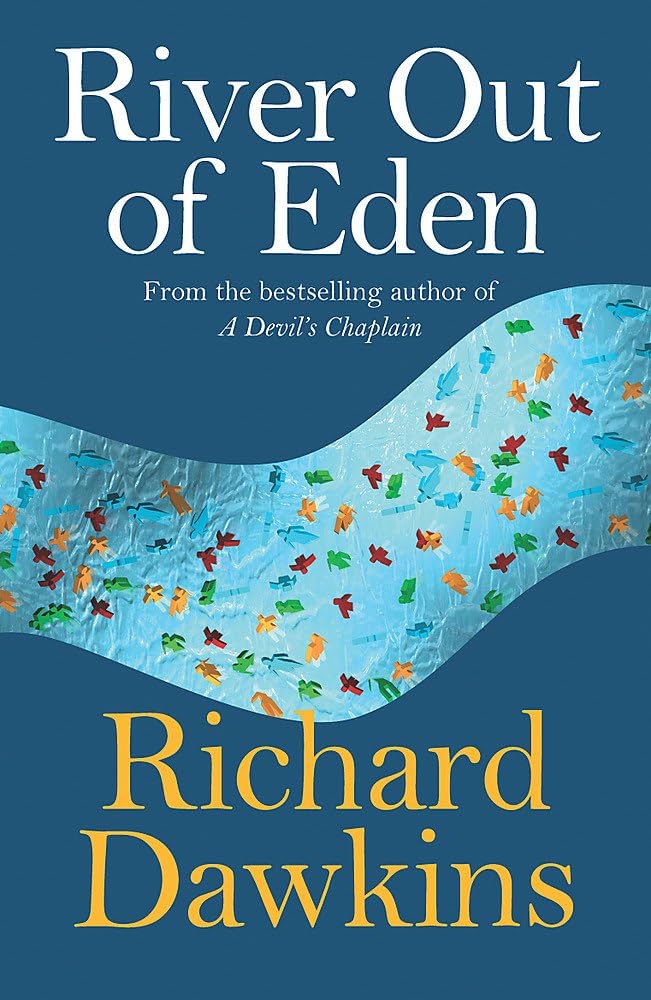
A Darwinian View of Life
“And a river went out of Eden to water the garden.” - Genesis 2:10
Nature, it seems, is the popular name For mil-liards and milliards and milliards Of particles playing their infinite game Of billiards and billiards and billiards. —Piet Hein
Piet Hein captures the classically pristine world of physics. But when the ricochets of atomic billiards chance to put together an object that has a certain, seemingly innocent property, something momentous happens in the universe. That property is an ability to self-replicate; that is, the object is able to use the surrounding materials to make exact copies of itself, including replicas of such minor flaws in copying as may occasionally arise. What will follow from this singular occurrence, anywhere in the universe, is Darwinian selection and hence the baroque extravaganza that, on this planet, we call life. Never were so many facts explained by so few assumptions. Not only does the Darwinian theory command super-abundant power to explain. Its economy in doing so has a sinewy elegance, a poetic beauty that outclasses even the most haunting of the world's origin myths.
The other feature of earthly life that impresses us is its luxuriant diversity: as measured by estimates of species numbers, there are some tens of millions of different ways of making a living. Another of my purposes is to convince my readers that "ways of making a living" is synonymous with "ways of passing DNA-coded texts on to the fu-ture." My "river" is a river of DNA, flowing and branching through geological time, and the metaphor of steep banks confining each species' genetic games turns out to be a surprisingly powerful and helpful explanatory device.
Of all organisms born, the majority die before they come of age. Of the minority that survive and breed, an even smaller minority will have a descendant alive a thousand generations hence. This tiny minority of a minority, this pro-genitorial elite, is all that future generations will be able to call ancestral. Ancestors are rare, descendants are common.
Genes do not improve in the using, they are just passed on, unchanged except for very rare random errors. It is not suc cess that makes good genes. It is good genes that make success, and nothing an individual does during its lifetime has any effect whatever upon its genes. Those individuals born with good genes are the most likely to grow up to become successful ancestors; therefore good genes are more likely than bad to get passed on to the future. Each generation is a filter, a sieve: good genes tend to fall through the sieve into the next gen-eration; bad genes tend to end up in bodies that die young or without reproducing. Bad genes may pass through the sieve for a generation or two, perhaps because they have the luck to share a body with good genes. But you need more than luck to navigate successfully through a thousand sieves in succession, one sieve under the other. After a thousand successive generations, the genes that have made it through are likely to be the good ones.
Genes can buy their way through the sieve, not only by assisting their own body to become an ancestor but by assisting the body of a relation to become an ancestor.
In every one of your cells, half your mother's genes rub shoulders with half your father's genes. Your maternal genes and your paternal genes conspire with one another most intimately to make you the subtle and indivisible amalgam you are. But the genes themselves do not blend. Only their effects do. The genes themselves have a flintlike in-tegrity. When the time comes to move on to the next generation, a gene either goes into the body of a given child or it does not. Paternal genes and maternal genes do not blend; they recombine independently. A given gene in you came either from your mother or your father. It also came from one, and only one, of your four grandpar-ents; from one, and only one, of your eight great-grandparents; and so on back.
DNA characters are copied with an accuracy that rivals anything modern engineers can do. They are copied down the generations, with just enough occasional errors to introduce variety.
Genes survive down the ages only if they are good at building bodies that are good at living and reproducing in the particular way of life chosen by the species. But there is more to it than this. To be good at surviving, a gene must be good at working together with the other genes in the same species-the same river. To survive in the long run, a gene must be a good compan-ion. It must do well in the company of, or against the background of, the other genes in the same river. Genes of another species are in a different river. They do not have to get on well together— not in the same sense, anyway-for they do not have to share the same bodies.
Because "cousin" for our purposes includes second cousins, fifth cousins, sixteenth cousins and so forth. When you count cousins as distant as that, every marriage is a marriage between cousins.
Nature is not cruel, only pitilessly indiffer-ent. This is one of the hardest lessons for humans to learn. We cannot admit that things might be neither good nor evil, neither cruel nor kind, but simply callous-indifferent to all suffering, lacking all purpose.
If the universe were just electrons and selfish genes, meaningless tragedies like the crashing of this bus are exactly what we should expect, along with equally meaningless good fortune. Such a universe would be neither evil nor good in intention. It would manifest no intentions of any kind. In a universe of blind physical forces and genetic replication, some people are going to get hurt, other people are going to get lucky, and you won't find any rhyme or reason in it, nor any justice. The universe we observe has precisely the properties we should expect if there is, at bottom, no de-sign, no purpose, no evil and no good, nothing but blind, pitiless indifference.
DNA neither cares nor knows. DNA just is. And we dance to its music.
Shared from Twos ✌️
Use code “baller”