

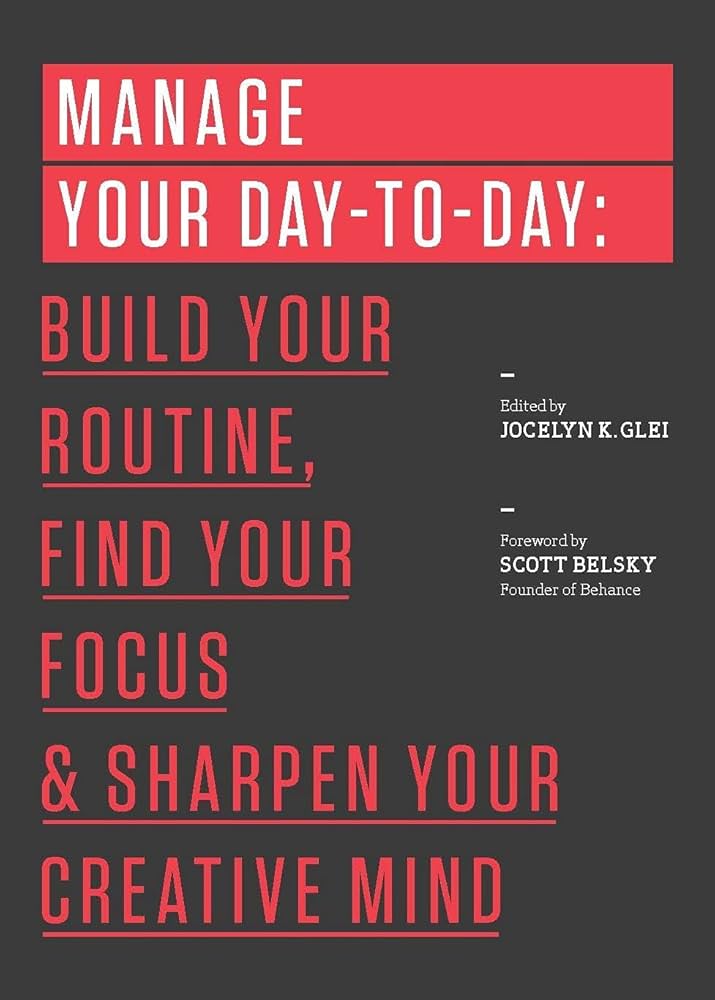
Manage Your Day-to-Day
Jocelyn Glei
5/4/26
Build Your Routine, Find Your Focus, and Sharpen Your Creative Mind
As the legendary inventor Thomas Edison famously said, "Genius is 1 percent inspiration, and 99 percent per-spiration."
To make great ideas a reality, we must act, experiment, fail, adapt, and learn on a daily basis.
Our individual practices ultimately determine what we do and how well we do it.
Through our constant connectivity to each other, we have become increasingly reactive to what comes to us rather than being proactive about what matters most to us.
Truly great creative achievements require hundreds, if not thousands, of hours of work, and we have to make time every single day to put in those hours. Routines help us do this by setting expectations about availability, aligning our workflow with our energy levels, and getting our minds into a regular rhythm of creating.
At the end of the day—or, really, from the beginning-building a routine is all about persistence and consistency. Don't wait for inspiration; create a framework for it.
If you want to create something worthwhile with your life, you need to draw a line between the world's demands and your own ambitions.
The single most important change you can make in your working habits is to switch to creative work first, reactive work second. This means blocking off a large chunk of time every day for creative work on your own priorities, with the phone and e-mail off.
"I don't wait for moods. You accomplish nothing if you do that. Your mind must know it has got to get down to work." - Pearl S. Buck
We tend to overestimate what we can do in a short period, and underestimate what we can do over a long period, provided we work slowly and consistently.
Frequency makes starting easier. Getting started is always a challenge. It's hard to start a project from scratch, and it's also hard each time you re-enter a project after a break. By working every day, you keep your momentum going. You never have time to feel detached from the process. You never forget your place, and you never need to waste time reviewing your work to get back up to speed or reminding yourself what you've already done. Because your project is fresh in your mind, it's easy to pick up where you left off.
Progress is reassuring and inspiring; panic and then despair set in when you find yourself getting nothing done day after day. One of the painful ironies of work life is that the anxiety of procrastination often makes people even less likely to buckle down in the future.
"We are what we repeatedly do. Excellence, then, is not an act, but a habit." - Aristotle
The strategy is to have a practice, and what it means to have a practice is to regularly and reliably do the work in a habitual way.
Lots and lots of people are creative when they feel like it, but you are only going to become a professional if you do it when you don't feel like it.
Being creative means that you have to sell your ideas.
I've never met anybody who is great at selling who was born that way. I think that all the people who have figured out how to do this for a living have figured it out because it was important to them, not because it came naturally. Whereas I know tons of people who call themselves artists who were born with talents and never really had to push themselves to be good at it. They think they are entitled to make a living at this thing, but they are not willing to do the hard part— selling-that everyone finds hard.
These people sabotage themselves be cause the alternative is to put themselves into the world as someone who knows what they are doing. They are afraid that if they do that, they will be seen as a fraud. It's incredibly difficult to stand up at a board meeting or a conference or just in front of your peers and say, "I know how to do this. Here is my work. It took me a year. It's great." This is hard to do for two reasons: (1) it opens you to criticism, and (2) it puts you into the world as someone who knows what you are doing, which means tomorrow you also have to know what you are doing, and you have just signed up for a lifetime of knowing what you are doing.
"You can't TRY to do things, you must simply DO them." - Ray Bradbury
"I's not the load that breaks you down, it's the way you carry it." - Lena Horne
How do you meditate? Find a quiet space and sit. Stay upright, keep your eyes open but not focused on anything in particular, and breathe through your nose. Start by noticing your posture, your body. Then focus your attention on your breath, as it comes in and out of your body. Notice your thoughts coming up, acknowledge them, but don't engage with them. Always return your attention to your breath. Keep doing this for at least a few minutes, and you're done.
Do your most meaningful creative work at the beginning of your day, and leave "reactive work"—like responding to e-mail or other messages—-for later.
Commit to working on your project at consistent intervals-ideally every day —to build creative muscle and momentum over time.
Move rhythmically between spending and renewing your energy by working in ninety-minute bursts and then taking a break.
Make a point of spending some time alone each day. It's a way to observe unproductive habits and thought pro-cesses, and to calm your mind.
Show up, whether you feel inspired or not.
In 1971, renowned social scientist Herbert Simon ob-served, "What information consumes is rather obvious: it consumes the attention of its recipients. Hence a wealth of information creates a poverty of attention."
Amid this constant surge of information, attention has become our most precious asset. To spend it wisely, we must develop a better understanding of how temptation works on our brains, cultivate new strategies for enhancing our self-control, and carve out time to truly focus on big, creative tasks.
In a world filled with distraction, attention is our competitive advantage. Look at each day as a challenge-and an opportunity—to keep your eye on the prize.
Start with small blocks of focused time and then gradually work yourself up to longer durations. A good rule of thumb is to begin with an hour at a time, then add fifteen minutes to each session every two weeks. The key, however, is to never allow distrac-tion. If you give in and quickly check Face-book, cancel the whole block and try again later. Your mind can never come to believe that even a little bit of distraction is okay during these blocks.
Tackle a clearly identified and isolated task. If you have to write an article, for example, do the research ahead of time, so that when you get to your focus block you can put your word processor in fullscreen mode and turn your entire attention to your prose.
Consider using a different location for these blocks. Move to a different room, or a library, or even a quiet place outside to perform your focused work. When possible, do your work with pen and paper to avoid even the possibility of online distraction.
"It is not enough to be busy, (the ants are busy) we must ask: What are we busy about?” - Henry David Thoreau
"The most basic form of human stupidity is forgetting what we are trying to accomplish." - Friedrich Nietzsche
"Creation is in part merely the business of forgoing the great and small distractions." - E.B. White
Most of us find very little time to casually explore, follow our whims, or think big, but this capacity is a major competitive advantage in the era of constant connect-ivity.
As we tune in to our devices during every moment of transition, we are letting the incredible potential of serendipity pass us by.
Today's challenge is to keep your focus and preserve the sanctity of mind required to create, and to ultimately make an impact in what matters most to you.
Be aware of the cost of constant connec-tion. If your focus is always on others—-and quenching your appetite for information and external validation—you will miss out on the opportunity to mine the potential of your own mind.
Create windows of non-stimulation in your day. Make this time sacred and use it to focus on a separate list of two or three things that are important to you over the long term. Use this time to think, to digest what you've learned, and to plan.
Listen to your gut as much as you listen to others. With all the new sources of communication and amplification, don't let yourself be persuaded by the volume of the masses. Nothing should resonate more loudly than your own intuition.
Stay open to the possibilities of seren-dipity. The most important connections-whether with people, ideas, or mistakes that lead to key realizations-often spring from unexpected circumstances. By being fully present where you are, you let chance (and the curious universe we live in) work its magic.
You are the steward of your own potential. The resources within you-and around you -are only tapped when you recognize their value and develop ways to use them. Whatever the future of technology may hold, the greatest leaders will be those most capable of tuning in to themselves and harnessing the full power of their own minds.
Book time on your calendar for un-interrupted, focused work-and respect those blocks of time as you would any client meeting.
Tackle the projects that require "hard focus" early in your day. Self-control-and our ability to resist distractions-declines as the day goes on.
Marking progress is a huge motivator for long-term projects. Make your daily achievements visible by saving iter-ations, posting milestones, or keeping a daily journal.
Alternate challenging creative work with more "mindless" tasks to give your brain time to rest and refuel.
Take a break from checking your smartphone during transitional moments, and open yourself up to opportunity and serendipity.
Technology should be a tool, but if we do not keep our wits about us, it can easily become our taskmaster.
"The difference between successful people and very successful people is that very successful people say 'no' to almost everything." - Warren Buffett
• Is it necessary to share this? Will it add value to my life and for other people? • Can I share this experience later so I can focus on living it now? • Am I looking for validation? Is there something I could do to validate my-self? • Am I avoiding something I need to do instead of addressing why I don't want to do it? • Am I feeling bored? Is there something else I could do to feel more purposeful and engaged in my day? • Am I feeling lonely? Have I created opportunities for meaningful connection in my day? • Am I afraid of missing out? Is the gratification of giving in to that fear worth missing out on what's in front of me? • Am I overwhelming myself, trying to catch up? Can I let go of yesterday's conversation and join today's instead? • Can I use this time to simply be instead of looking for something to do to fill it? • Do I just want to have mindless fun for a while?
"You can do anything, but not everything." - David Allen
Be conscious of your body. Breathing deeply and regularly can decrease your stress levels and help you make better decisions.
"Your mind will answer most questions if you learn to relax and wait for the answer." - William S. Burroughs
"The artist who aims at perfection in everything achieves it in nothing." - Eugene Delacroix
Look out for the telltale signs that your tank is empty, and use them as a cue to take a break and let your unconscious take the strain. Relax or apply yourself to a completely different type of project. You may not have two years to set your project aside if a deadline is looming, but even a short break can work wonders when you're running low on inspiration.
Give yourself permission to write, draw, or otherwise express whatever comes out —on the understanding that you will not make it public, at least for a while. Privacy will make it easier to get the draft version done. Then take a break before deciding whether you want to show it to an audience.
Make a virtue of necessity and set yourself the creative challenge of achieving as much as possible with what you have.
Keep your inner perfectionist in check by defining what finished looks like at the beginning of a project. And when you get there, stop!
Repetition is the enemy of insight. Take unorthodox-even wacky-approaches to solving your stickiest problems and see what happens.
Resistance is that self-created and self-perpetuated, invisible, impersonal, indefatigable force whose sole aim is to prevent us from doing our work, from becoming our best selves, and from rising to the next level of competence, integrity, and gen-erosity.
A professional is someone who can keep working at a high level of effort and ethics, no matter what is going on —for good or ill-around him or inside him.
"Inspiration is for amateurs, the rest of us just show up and get to work." - Chuck Close
Shared from Twos ✌️
Use code “baller”