

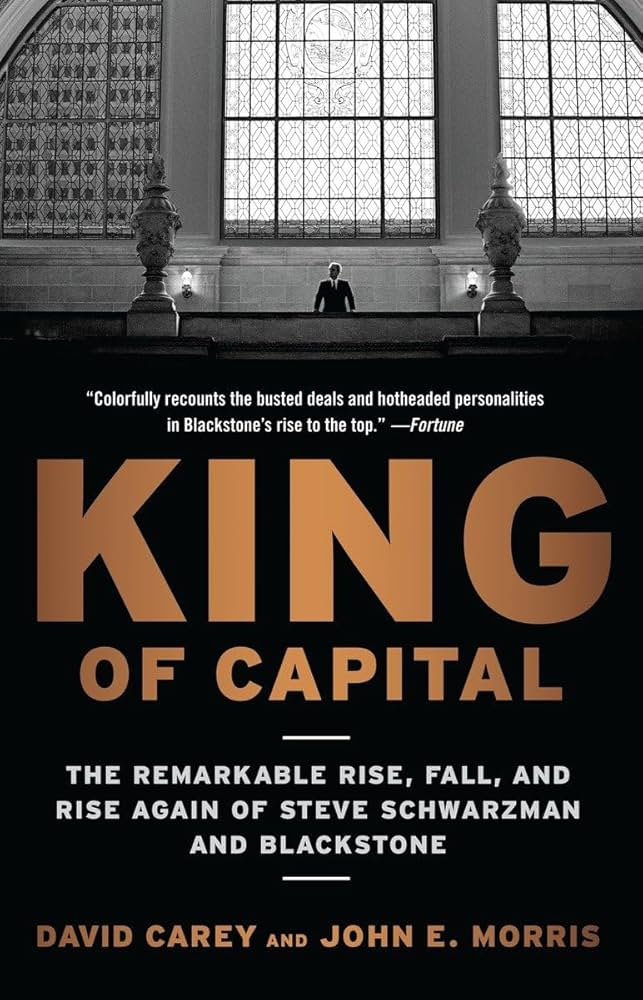
King of Capital
David Carey & John E. Morris
1/11/26
The remarkable rise, fall, and rise again of Steve Schwarzman and Blackstone
Private equity is the business of buying companies with an eye to selling them a few years later at a profit.
Much of what investment banks do, despite the term, involves no investing and requires little capital. While commercial and consumer banks take deposits and make loans and mortgages, investment bankers mainly sell services for a fee. They provide financial advice on mergers and acquisitions, or M&A, and help corporations raise money by selling stocks and bonds.
A basis point is Wall Street parlance for one one-hundredth of a percentage point, a fractional difference that can translate into big gains and losses on large trades or loans. Thus, 100 basis points equals 1 percent of interest.
Remember, I don’t like to lose money.
"I didn't want people lobbying me at my desk or whispering to me in a corridor. Every deal would get vetted in front of the entire partner-ship, and not just once," Schwarzman says. "It would be the job of the partners to poke holes and lay out the risks, without anyone getting huffy or defensive. It wasn't a personal attack. People had to realize it wasn't their deal being criticized; it was the firm's deal, and the process was to protect the firm. Had we not had Edgcomb, people might still be lining up at my door."
Doing nothing is as good as doing something
The losses taught the firm several lessons, he says. First, "don't pay too much when you're buying cyclicals," he says. Second, "don't have ambitious tum-around expectations for medium-sized companies. Don't expect to reinvent them." Third, if an investment calls for reengineering operations, "don't have it be a Blackstone-manufactured plan." Rather, develop a plan in consultation with seasoned executives and consultants know-edgeable enough to judge if the plan will fly.
Timing is everything when you are borrowing to buy a cyclical company. Like cliff diving in Acapulco, plunging in too soon or too late can be disastrous, which is why many private equity firms steer clear of cyclical businesses. Nimbly timed, however, a leveraged investment at the bottom of the cycle can magnify any earnings gains. In addition, valuation multiples for cyclical companies tend to rise at the same time that profits do because buyers will pay a higher multiple of cash flow or earnings when those are on the upswing. Harness both the earnings growth and the increase in valuations, and returns can shoot off the charts. The exit must be timed as deftly as the entry, how-ever, because in a declining economy multiples can recede at the same time earnings are falling. A company that sold for seven times earnings in good times could easily trade for just six times in a down market. If earnings drop at the same time, the two factors together could slice the value by a third, leaving the company worth less than its debt and wiping out the value of the equity, at least on paper. That is the inherent risk of leverage.
With the business commanding headlines every week, and word spreading of the enormous profits being churned out by buyour funds, the broader investing world wanted in, and it is an immutable law that when Wall Street senses an appetite for "product," it will find a way to fulfill that desire.
The product in this case would take the form of the business development corporation, or BDC. The BDC was a creature of the U.S. tax code, which gives tax breaks to certain kinds of investment funds that lend to midsized businesses. As long as a BDC pays out almost all of its income each year to shareholders, it is exempt from most corporate taxes.
Timing is everything.
Being the prime mover is critical.
Barbarians at the gate #book
Wall Street #movie
Buyout firms almost always retain substantial stakes in companies for years after they have gone public.